Caesar and God
July 23, 2026
4
min
read

A bishop of a New York diocese as well as four communities of religious sisters have filed a lawsuit against New York government officials, in response to the passing of a law that would force them to participate in the process of physician-assisted suicide.
The suit was filed on the grounds that the law violates Catholic providers’ First Amendment right to the free exercise of religion. While plenty of states have legalized physician-assisted suicide at this point, they normally have an “opt-out” clause; New York’s, though, “is among the narrowest in the nation,” the lawsuit argues. Those working in Catholic-run facilities are therefore at high risk of having to violate their consciences to maintain their practice, by being forced to carry out a procedure (or refer patients to a provider who will carry out the procedure) that they believe is gravely wrong.
The scenario raises a curious point: why does the New York government care this much? Why place such a high priority on getting even Catholic institutions to participate in physician-assisted suicide? As long as the procedure is available somewhere, why does it need to be available everywhere?
This becomes one place where we can recognize both the place Christianity has had in establishing rights we tend to think of as thoroughly American, and the way such cultural Christianity is wearing through, with values like freedom of religion being exposed as less integral to the fundamentally American identity than we may think.
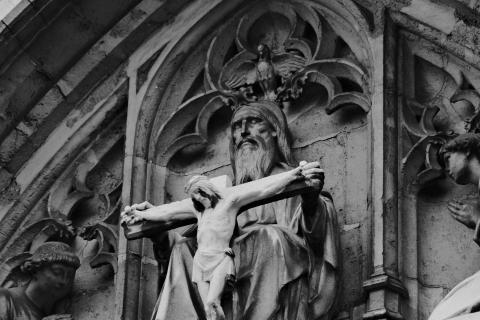
To a Christian mind, the principle behind the notion of freedom of religion is “Give to God what is God’s and to Caesar what is Caesar’s.” This line from Jesus is not necessarily intuitive; indeed, it’s tended to throw earthly governments for a loop. But for us, it’s also been the source of many of our political freedoms. The idea behind it is that earthly governments have an important place, but it is not an absolute place. Human governments have the authority to do many things as they care for the common good, but what they do not have the right to do is define what is right and wrong on their own authority. Only God can do that. Thus recourse to the law of God in matters of conscience has been a protection for human freedom, providing a defense against arbitrary and soul-harming governance.
But when Christian principles drain out of the cultural soil, those responsible for our common life suddenly have space to presume that they have the authority, and maybe even the obligation, to originate their own morality based on their own dogmatic religious beliefs. They have space to presume, as well, that it’s their duty to enforce that morality with all the power of the state.
And that seems to be precisely what’s been happening among neo-Gnostic progressives. They’ve insisted that the social world be shaped by their moral practices, and as that agenda has put down deeper and deeper roots, rights like religious freedom and freedom of conscience have become more of an obstacle than a protection. Why? Because it was Christianity that provided the necessary hermeneutic for such freedoms to be cherished as values in the first place. Outside of it, there’s really no reason to pursue and treasure those freedoms. And that’s not because non-Christian people are so innately tyrannical, but because Christians have an entirely different conception of the nature of the state’s authority and of the private person’s conscience, without which those freedoms don’t make sense.
Thus, as a result of the waning of Christianity in this country, the hostility of those insisting on forcing their views onto others has had space to rise to the surface. And probably much of that hostility has come not just from systematically working out a different morality and theory of governance, but also because Christianity is recognized as the main stronghold of the traditional morality and views about governance that they wish to overthrow. Thus in something like life issues, it’s not enough for progressive morality’s adherents to be able to act as they wish; such adherents want to stamp out any possible resistance to their religious program. And without a protection for conscience, arbitrary and soul-harming governance can pursue that project more readily.
So: let’s pray for the bishop and religious sisters of the Diocese of Rockville Centre – that their cause would be upheld, such that they can maintain their freedom to give to Caesar what is Caesar’s, and to God what is God’s.